What is biological treatment? The difference between aerobic treatment and anaerobic treatment.
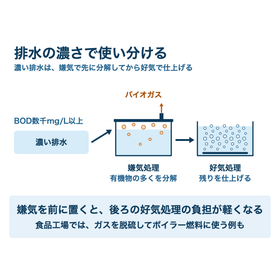
Biological treatment that decomposes organic matter in wastewater using the power of microorganisms. This explains the differences between aerobic treatment, which uses oxygen, and anaerobic treatment, which does not, as well as how they can be combined.
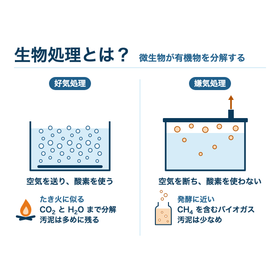
Biological treatment is a method of breaking down organic matter in wastewater through the action of microorganisms. It is widely used, from household septic tanks to industrial wastewater treatment. Biological treatment is also central to the wastewater treatment in food factories. ■ Microorganisms "eat" and clean Microorganisms take in organic matter from wastewater. Some of it is broken down into carbon dioxide and water, while the rest becomes new microbial cells or sludge. The increased microorganisms are then separated from the water as excess sludge. ■ There are aerobic and anaerobic treatments! Microorganisms can either live using oxygen or work in environments without oxygen. Depending on which one is used, the treatment is broadly divided into two types: 1. Aerobic treatment: Air is supplied, and microorganisms that use oxygen break down the organic matter. 2. Anaerobic treatment: Air is cut off, and microorganisms that do not use oxygen break down the organic matter. ■ How can we compare it to a campfire and fermentation? Aerobic treatment is similar to a campfire that uses oxygen to convert organic matter into carbon dioxide and water, but the increased microorganisms remain as a larger amount of sludge. Anaerobic treatment is closer to fermentation occurring in a tank without oxygen, producing biogas that contains methane, with less sludge. Please feel free to consult us first.
- Company:トリイ
- Price:Other